
Thyroid Eye Disease (TED) Online Support Groups
Join a supportive and informative online community for individuals dealing with thyroid eye disease. TED Online Support Groups provide a safe space for you to participate in a conversation about what you and others are going through as each navigates the TED journey. These one hour, peer-facilitated, and topic driven online groups use Zoom to connect our global community. You can choose to have your camera off or on. Come as you are. And wear sunglasses if that works best for you. You can simply listen in or share according to your comfort level.
To attend a TED Online Support Group, please fill out the form below to be added to our email list. We will keep you informed about future meet ups.
Because we are a community and not medical professionals, it is important to follow the guidelines of TED Online Support Groups as outlined below – click the plus sign.
The above TED eyes drawing is by Roseanne and is part of the INSIDE OUT TED ART project.
TED Online Peer Support – Join the Conversation
Friday, March 13 @ 1pm PT / 2pm MT / 3pm CT / 4pm ET
Wednesday, March 25 @ 4pm PT / 5pm MT / 6pm CT / 7pm ET
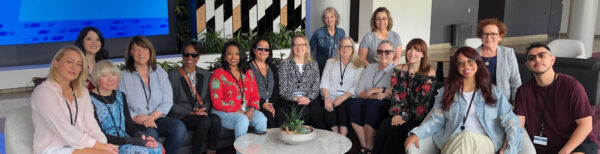
Please join us for a TED Community Peer Support Meet Up – a heartfelt, uplifting, and solution-oriented conversation about living with thyroid eye disease (TED) and Graves’ disease.
March is Autoimmune Awareness Month, and together we’ll explore how to navigate information, wellness advice, and online spaces in ways that support healing, confidence, and emotional wellbeing.
Below are the topics for the one-hour meeting that will take place on Zoom. (International participants welcomed!)
You can be on or off camera. This is a safe space so make yourself comfortable!
Scroll down and use the red button to access the ZOOM log in credentials.
Have a topic you want to discuss? Let us know: hello@tedcommunity.org
JOIN THE CONVERSATION!
Session Description:
TED Support Groups are topic-driven conversations dedicated to the most urgent and timely topics affecting those living with thyroid eye disease and Graves’ disease. These peer gatherings offer understanding, shared wisdom, and practical support from people who truly understand the journey.
Talking Points:
(Chat Topic) What is uppermost in your mind related to TED right now?
A brief check-in to share what feels most present — a challenge, a win, a question, or simply how you are feeling today.
Navigating Wellness Culture with Autoimmune Disease
Topic Faciliated by Chesna
Many people living with TED explore diets, supplements, lifestyle changes, and wellness trends hoping to reduce inflammation or prevent flares. While some approaches may help, the overwhelming amount of advice can also create confusion, anxiety, or even self-blame.
How do we determine what is helpful — and what may not be right for us? Let’s discuss ways to approach wellness information with clarity, balance, and self-compassion.
Social Media: Support, Connection, and Misinformation
Online communities can reduce isolation and help us feel seen — but social media can also spread misinformation or increase fear.
Together we’ll explore:
- how to use social media as a source of connection rather than stress
- recognizing trustworthy information
- protecting emotional wellbeing while staying informed
Living with Autoimmunity: Finding Your Personal Balance
Autoimmune disease often asks us to rethink how we care for ourselves — physically and emotionally.
We’ll talk about:
- listening to your body without pressure or judgment
- managing information overload
- small practices that help restore stability and resilience while living with TED and Graves’ disease
Wherever you are in your TED journey, you are not alone. We learn from one another — and we heal together.
—
Facilitators:
Chesna Duffy Adams
Chesna is an avid nature lover who spends more time than she cares to admit birding. She was diagnosed with thyroid cancer and Graves’ in 2013 and experienced little to no symptoms for over 10 years following a total thyroidectomy. After a Graves’ flare in early 2024, she was diagnosed with TED. Feeling scared and alone, she happened upon the TED Community Organization’s website, where she found understanding, community, and hope. Now, she wants to offer that same sense of support and safety to others living with TED.
Christine Gustafson
Christine Gustafson is the Founder, CEO, and Executive Director of the TED Community Organization, a global nonprofit dedicated to supporting those living with thyroid eye disease (TED). An “accidental leader,” Christine stepped into advocacy by simply trying to help fellow patients navigate the isolating and often overwhelming TED journey. Today, she leads an organization that is uniting patients, physicians, advocacy groups, and industry partners worldwide to foster education, support, and connection.
Susan Roberts, Pharm.D.
Dr. Roberts is a pharmacist living in Maine. She has worked in community pharmacy in Oklahoma and Maine, and worked during the pandemic administering vaccines to nursing homes and long-term care facilities. Diagnosed with TED in 2018, she struggled with symptoms and the search to find high quality disease information. The TED Community has filled that gap. She is delighted to help other patients along their journeys through monthly support groups and/or individual meetings.