

Thyroid Eye Disease (TED) & Graves’ Disease Clinical Trials


Kriya Therapeutics is a biopharmaceutical company developing gene therapies to address common chronic diseases of high unmet need. Our mission is to make gene therapies accessible – not just for the few – but for the many.
Kriya is developing KRIYA-586, an investigational one-time gene therapy for thyroid eye disease (TED) designed to be delivered by an in-office peribulbar injection. KRIYA-586 is an adeno-associated virus (AAV) gene therapy engineered to express an antibody that inhibits Insulin-Like Growth Factor 1 Receptor (IGF1R).
The RECLAIM Study is an adaptive Phase 1/2 multicenter study evaluating the safety, tolerability, pharmacokinetics, and efficacy of KRIYA-586 in patients with moderate to severe TED.
Thyroid Eye Disease Clinical Trial
https://clinicaltrials.gov/study/NCT07404111
KRIYA-586 is an investigational therapy and has not been approved as safe or effective by the FDA or any other regulatory health authority.

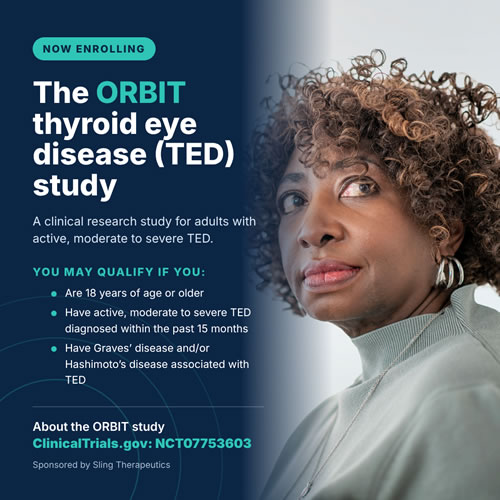
Sling Therapeutics: The ORBIT Study (Phase 3) | Now Enrolling
Could a pill help treat TED?
Sling Therapeutics is studying linsitinib, an investigational oral tablet that targets IGF-1R, a validated target in TED. The global ORBIT trial (NCT07753603) is enrolling about 130 adults with moderate-to-severe active thyroid eye disease.
- How it works: Participants are randomly assigned to linsitinib 150 mg or placebo, taken by mouth twice daily for 24 weeks. An optional 24-week open-label extension follows.
- What’s measured: Mainly whether bulging of the eye (proptosis) is reduced. The study also tracks inflammation (Clinical Activity Score) and quality of life.
- Why it matters: ORBIT builds on the Phase 2b/3 LIDS trial, which met its primary endpoint of reducing proptosis.
- See if you may qualify: www.slingtx.com/clinical-trials · ClinicalTrials.gov: NCT07753603
Note: Linsitinib is not approved as a marketed product at this time. Clinical trials are required by the FDA to demonstrate the safety and efficacy of a potential medication before general availability.

GRAVES’ DISEASE CLINICAL TRIAL
Immunovant is conducting a clinical trial for Graves’ Disease. A Study to Assess the Efficacy, Safety, and Tolerability of imeroprubart (IMVT-1402) as Treatment for Adult Participants With Graves’ Disease.
Brief Summary
This is a study to assess the efficacy, safety, and tolerability of imeroprubart in adult participants with Graves’ disease (GD) who are hyperthyroid despite antithyroid drug (ATD) treatment.
The primary objective of this study is to evaluate the efficacy of imeroprubart versus placebo as assessed by T3 (total triiodothyronine [T3] or free triiodothyronine [FT3]), free thyroxine (FT4), thyroid-stimulating hormone (TSH), and ATD dose at Week 26.
Imeroprubart (IMVT-1402) is an investigational drug. Efficacy and safety have not been established and it is not approved for any use by any regulatory authority.
Graves’ Disease Clinical Trial
https://clinicaltrials.gov/study/NCT06727604

Official Study Name:
A Study to Assess Efficacy and Safety of Efgartigimod PH20 SC PFS in Adult Participants With Graves’ Disease (VitaliThy)
https://clinicaltrials.gov/study/NCT07596849
https://clinicaltrials.gov/study/NCT07570316
ClinicalTrials.gov ID: NCT07596849
• Other study numbers: ARGX-113-25-GRD-3001; ARGX-113-25-GRD-3002
• 2025-524223-42-00 ( EU Trial (CTIS) Number )
• 2025-523333-26-00 ( EU Trial (CTIS) Number )
Mode of delivery: Subcutaneous injection via Prefilled Syringe (PFS)
Primary Outcome Measure:
Percentage of participants who are euthyroid (fT3, fT4, and TSH within normal ranges) off ATDs at week 24 in part A
Amgen is conducting a Clinical Trial to Investigate Teprotumumab Subcutaneous Administration Compared With Placebo in Male and Female Adult Participants With Moderate-to-severe Active Thyroid Eye Disease
Thyroid Eye Disease Clinical Trial
https://clinicaltrials.gov/study/NCT06248619
Brief Summary
The study consists of a randomized double-masked, placebo-controlled, parallel-group, multicenter trial with an optional open-label treatment period for proptosis non-responders who complete the Double-masked Treatment Period.
Detailed Description
The main objective of the study is to evaluate the effect of teprotumumab subcutaneous administration versus placebo on the proptosis responder rate (ie, the percentage of participants with a ≥ 2-mm reduction from Baseline in the study eye without deterioration [≥ 2-mm increase] of proptosis in the fellow eye) at Week 24.
IN THE NEWS
THOUSAND OAKS, Calif., April 6, 2026 /PRNewswire/ — Amgen (NASDAQ: AMGN) today announced positive topline results from a Phase 3 trial of TEPEZZA (teprotumumab-trbw) administered by subcutaneous injection via an on-body injector (OBI) in participants with moderate-to-severe active Thyroid Eye Disease (TED). TEPEZZA OBI provides comparable efficacy to, and builds upon the success of, intravenous (IV) TEPEZZA, the first and only medicine approved for the treatment of TED, which has now treated more than 25,000 patients worldwide.

Viridian is a biotechnology company based in Waltham, Massachusetts focused on discovering and developing potential new medicines for people living with autoimmune and rare diseases.
Leveraging our team’s expertise in antibody discovery, protein engineering, and clinical development, Viridian is studying multiple potential new treatment options in clinical trials for people living with thyroid eye disease (TED). All of Viridian’s TED clinical trials are fully enrolled, therefore no longer seeking additional participants. For more information on these clinical trials, please visit https://clinicaltrials.gov/search?lead=Viridian or speak with a healthcare provider.

We’re Genentech. Our love of science compels us to explore new avenues of research and untapped technological possibilities in pursuit of solutions that reduce the burden of complex health challenges on patients.
As biotech’s original changemakers, we deliver life-changing breakthroughs – from creating the next generation of therapies, to accelerating the drug discovery process – improving healthcare access and outcomes for all patients.
We are inclusive, passionate, vibrant and courageous, constantly working towards a shared goal of a healthier future.
Genentech is committed to improving health outcomes within the communities we serve. We do this by supporting and promoting organizations and initiatives that offer new opportunities for care and by improving access to health services and information.
On Our Watch List
Alumis is investigating a medication for thyroid eye disease. Lonigutamab, a next-generation anti-IGF-1R, is being explored as a potential TED treatment, offering a convenient subcutaneous route of administration and safety benefit while retaining the clinically validated efficacy of an anti-IGF-1R.
More information:
https://www.alumis.com/pipeline/lonigutamab/
About TED Community Organization
This thyroid eye disease and Graves’ disease patient advocacy group frequently maintains an updated, accessible list of open TED clinical program.